Introduction Let’s be honest—navigating digital tools can sometimes feel like wandering through a maze without…
From Block
Subscribe to Updates
Get the latest creative news from FooBar about art, design and business.
Hexagoane: The Universal Language of Efficiency and Geometry
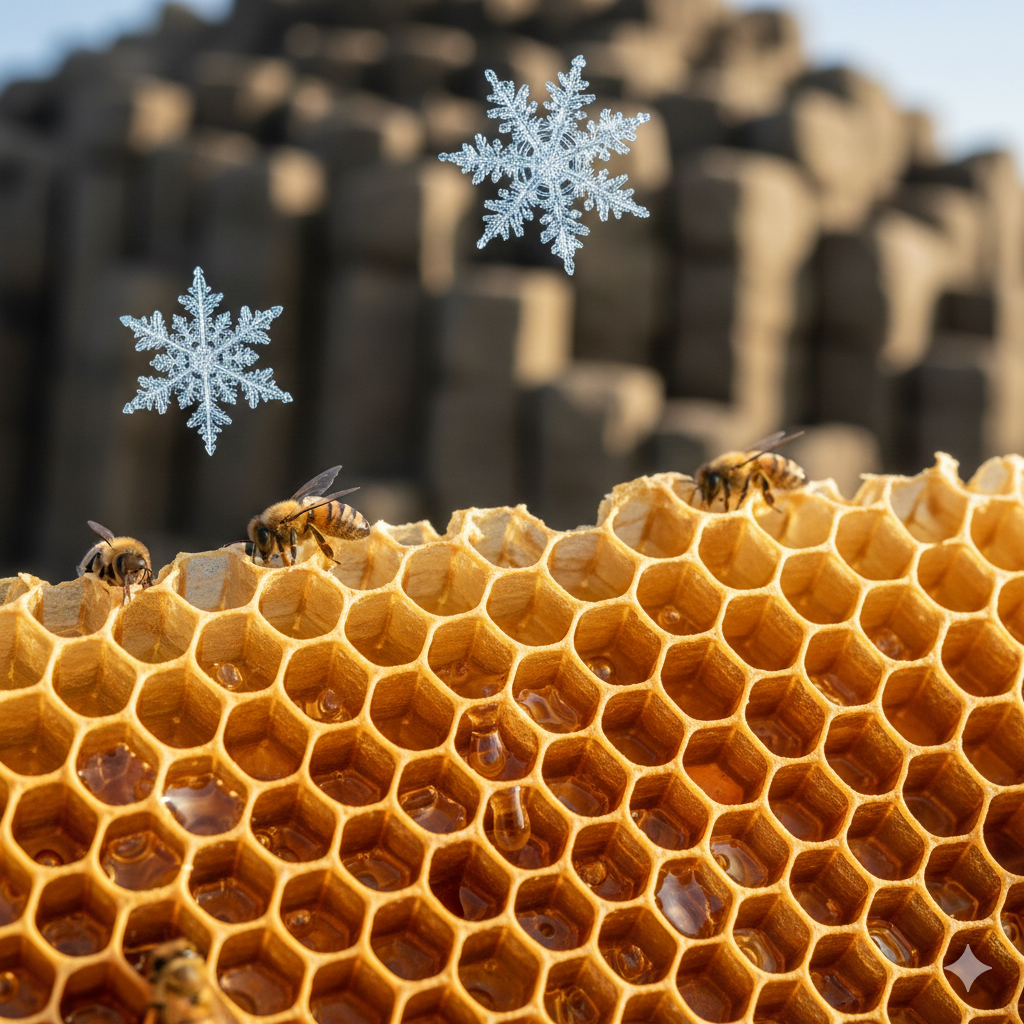
When we look at the world through a mathematical lens, few shapes appear as frequently or as purposefully as Hexagoane. From the microscopic structure of a snowflake to the massive storm swirling at the north pole of Saturn, this six-sided polygon is a recurring theme in the universe’s design language. But why does nature seem so obsessed with this specific shape?
The term Hexagoane—the Romanian word for hexagons—represents more than just a geometric figure; it embodies the principle of maximum efficiency. In a world governed by the laws of physics and thermodynamics, shapes are rarely accidental. They are the result of energy conservation and structural optimization.1
In this comprehensive guide, we will dive deep into the world of Hexagoane. We will explore their mathematical properties, their vital role in the natural world, and how modern engineering is leveraging their unique strengths to build the future of space exploration and nanotechnology.
The Geometry Behind Hexagoane
To understand why Hexagoane are so special, we first have to look at the numbers. A regular hexagon is a polygon with six equal sides and six equal internal angles.2 In the world of geometry, it sits in a “sweet spot” between the simplicity of a square and the smoothness of a circle.
Each internal angle of a regular hexagon is exactly 3$120^\circ$.4 Because the sum of the internal angles is 5$720^\circ$, these shapes can fit together perfectly without leaving any gaps or overlapping.6 This property is known as tessellation.
The Efficiency of the Perimeter
One of the most fascinating aspects of Hexagoane is their relationship between area and perimeter. If you want to cover a large surface area using the least amount of material for the “walls” of your cells, the hexagon is the most efficient shape.7
While a circle has the best area-to-perimeter ratio, you cannot tile circles together without leaving empty spaces. Among the shapes that can tile perfectly—triangles, squares, and hexagons—the hexagon provides the largest area for the shortest boundary. This mathematical truth is known as the Hexagonal Conjecture.
Mathematical Symmetry
The symmetry of Hexagoane is another reason they are so prevalent. They possess six-fold rotational symmetry.8 This means that if you rotate the shape by $60^\circ$ around its center, it looks exactly the same as it did before. This stability makes them incredibly resilient under pressure, as forces are distributed evenly across the six sides.9
Why Nature Prefers Hexagoane
If you walk into a forest or look under a microscope, you will find Hexagoane everywhere. Nature is a master of “cutting costs,” and since the hexagon uses the least amount of energy to create the most amount of space, it is the default choice for many biological processes.10
The Engineering of Honeycombs
The most famous example of Hexagoane in nature is the honeycomb built by honeybees.11 For centuries, philosophers and mathematicians wondered why bees didn’t build square or triangular cells.
Wax Conservation: Bees must consume a massive amount of honey to produce a small amount of wax.12
Storage Capacity: The hexagonal shape allows bees to store the maximum amount of honey while using the minimum amount of wax.13
Structural Integrity: The shared walls of the Hexagoane create a lightweight yet incredibly strong lattice that can support many times its own weight.
Snowflakes and Molecular Bonds
At the microscopic level, Hexagoane are dictated by the laws of chemistry. Water molecules (14$H_2O$) crystallize into a hexagonal lattice when they freeze.15 This is why every snowflake, despite its unique design, always has six sides or six points. The hydrogen bonds between water molecules naturally form a hexagonal arrangement because it is the most stable low-energy state for those molecules to occupy.
The Giant’s Causeway
In Northern Ireland, you can find the Giant’s Causeway, an area of about 40,000 interlocking basalt columns.16 These are almost all perfect Hexagoane. These were formed by ancient volcanic eruptions. As the thick lava cooled, it contracted. The stresses caused by the cooling process cracked the rock into hexagonal patterns, which is the most efficient way to release the tension.17
Hexagoane in Modern Science and Technology
Humans have spent thousands of years observing nature, and now we are using the lessons of Hexagoane to advance our own technology. From the way we build airplanes to the way we look at distant stars, the six-sided shape is a hero of modern engineering.
Graphene: The Wonder Material
Perhaps the most exciting application of Hexagoane is in the field of nanotechnology. Graphene is a single layer of carbon atoms arranged in a hexagonal lattice.18 It is essentially a 2D sheet of Hexagoane.
Strength: It is about 200 times stronger than steel.
Conductivity: It conducts electricity and heat better than almost any other material.
Flexibility: Despite its strength, it is incredibly flexible.
The hexagonal structure of graphene allows the atoms to bond with incredible tightness, creating a “molecular chain-link fence” that is nearly impossible to break.19
The James Webb Space Telescope (JWST)
If you look at the primary mirror of the James Webb Space Telescope, you won’t see one giant circle. Instead, you see 18 gold-coated Hexagoane. NASA chose this shape for several vital reasons:
Foldability: The telescope had to fit inside a rocket.20 A hexagonal mirror can be folded and then unfolded in space.21
Seamless Fit: Hexagons can tile together to create a large, roughly circular surface with no gaps.22
Efficiency: This arrangement allows for a huge light-collecting area without the “dead space” that would occur if the mirrors were circular.
Structural Advantages in Engineering
In the aerospace and construction industries, “honeycomb sandwich” panels are a standard for high-performance materials.23 By placing a layer of Hexagoane between two thin sheets of metal or carbon fiber, engineers create a material that is:
Extremely Lightweight: Most of the interior is just air.
High Strength-to-Weight Ratio: It can withstand massive compression forces.
Vibration Damping: The structure naturally absorbs and dissipates energy.
This is why the floors of commercial airplanes and the hulls of high-speed racing boats are often built using internal Hexagoane. It’s the closest humans have come to mimicking the efficiency of the beehive.
The Aesthetic and Cultural Impact of Hexagoane
Beyond math and science, Hexagoane have a profound impact on art, architecture, and even spirituality.24 The shape feels “organic” yet “ordered,” making it a favorite for designers.
Architecture and Floor Tiling
From ancient Roman mosaics to modern bathroom floors, hexagonal tiles have been used to create visually striking patterns.25 Because they lack the sharp 90-degree corners of squares, Hexagoane tend to look softer and more natural to the human eye.
In modern architecture, buildings like the Soumaya Museum in Mexico City are covered in thousands of hexagonal aluminum plates.26 This allows the building to have a curved, organic shape while using flat, easily manufactured components.
Symbolism and Philosophy
In various cultures, the hexagon has symbolized harmony and balance.27 Because it is the shape of the honeycomb, it is often associated with hard work, cooperation, and community. In sacred geometry, the hexagon is seen as a symbol of the “as above, so below” principle, connecting the celestial with the terrestrial.28
Exploring Hexagoane on a Planetary Scale
The most mind-blowing example of Hexagoane isn’t found on Earth, but on Saturn. At the planet’s north pole, there is a persistent cloud pattern that is a nearly perfect hexagon.29 Each side of this hexagon is wider than the diameter of Earth.
While scientists are still debating the exact cause, fluid dynamics experiments suggest that when there is a significant difference in wind speeds in the polar atmosphere, the resulting turbulence naturally organizes itself into Hexagoane. It is a testament to the fact that the laws of geometry apply to the entire universe, not just our small corner of it.
Conclusion: The Shape of the Future
The story of Hexagoane is a story of nature finding the path of least resistance. Whether it is a bee trying to save wax, a water molecule trying to freeze, or a NASA engineer trying to build a telescope, the hexagon is the ultimate solution for space-filling and structural integrity.
As we move toward a future defined by sustainable design and advanced materials, we will likely see Hexagoane playing an even larger role. From “hexagonal cities” designed for better traffic flow to the carbon-based electronics of tomorrow, this six-sided wonder remains the gold standard of efficiency.
Next time you see a honeycomb, a snowflake, or a tiled floor, take a moment to appreciate the Hexagoane. They are a reminder that there is a deep, mathematical order to our world, and it is a beautiful thing to behold.
Would you like me to create a detailed technical comparison table between hexagonal and square structures for engineering purposes?
Hexagoane Core
Diving into the three pillars of hexagonal efficiency.
Structural Integrity
The 120-degree angles in Hexagoane distribute weight better than any other shape, making them the preferred choice for aerospace and heavy-duty engineering.
Resource Efficiency
Proven by the "Hexagonal Conjecture," this shape covers the maximum area with the minimum boundary, saving materials in everything from honeycombs to packaging.
Natural Symmetry
From the molecular bonds of Graphene to the storm on Saturn, Hexagoane represent the universe's natural way of achieving perfect stability and balance.
Hexagoane Insights
Ready to use Hexagonal Design?
Start applying nature's most efficient shape to your projects today.